Tourism Authority Documents Ancient Fortified Town of Yeala, Answering President’s Call for Liberian-Led History

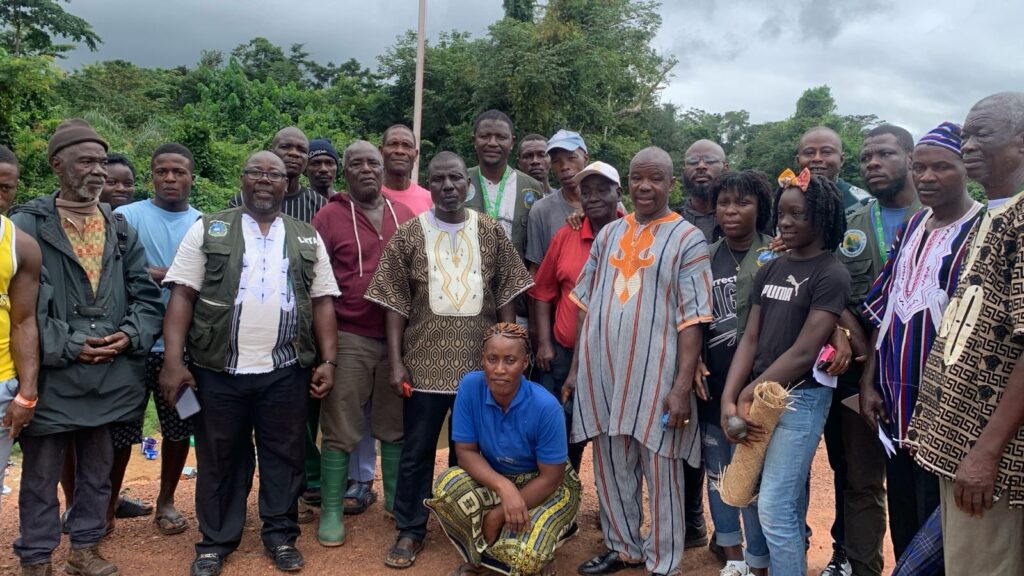
In the forested highlands of Liberia’s Nothern frontier, LNTA researchers record a three-century old wall, nine hidden tunnels and the sworn memory of griots; the 27th site in a growing national heritage registry.
ZORZOR, Lofa County ; Days after President Joseph Nyuma Boakai used his 179th Independence Anniversary address in Buchanan to challenge Liberians with a single searching question, “But who are we as Liberians?”, a research team from the Liberia National Tourism Authority (LNTA) returned from the Guinea frontier with one profound answer.
The mission was undertaken under the leadership of LNTA Director General, Hon. Princess Eva Cooper, whose administration has prioritized the documentation, preservation, and promotion of Liberia’s cultural heritage as a cornerstone of national identity and sustainable tourism development.
Between 17 and 19 July, a mission led by Deputy Director General for Planning, Research and Development, Atty. Dogba K. Norris, Jr., together with Director of Culture Mr. Emmanuel Levela, and a team of technical research officers travelled to the ancient town of Yeala in the Gizima Clan of Zorzor District. There, they carried out what is believed to be the first government led documentation, in the postwar era, of the oral history and tangible heritage of a community whose story has, until now, lived only in the memory of its elders.
The timing could hardly be more fitting. Speaking under this year’s theme, “Strengthening National Identity Through Liberian Led Historical Leadership,” the President urged Liberians themselves to lead in researching, preserving and interpreting the history that defines the national identity, reminding the nation that its story lives not only in archives, but in the oral traditions of its communities, its cultural heritage and the lived experiences of its people.
A LEGEND MADE TANGIBLE
What the mission found at Yeala reads like national legend made tangible. The town, its name meaning “the Water Side,” is guarded by the Kpaiyea Wall, a monumental double fortification of packed earth that community accounts date to more than three centuries ago; older than the Republic itself. Beneath and beyond it runs a system of nine hand carved tunnels, engineered so that every household could be evacuated during slave raids and warfare. The team authenticated five of the nine tunnels on site and located the concealed rear gate, hidden between two cotton trees; features kept as closely guarded secrets, until this mission, from all who were not of Yeala.
Crucially, the mission did not go uninvited. The elders of Yeala themselves petitioned the Office of the President, through the Minister of State for Presidential Affairs, asking the Government to come and receive a heritage they feared was slipping beyond the reach of a younger generation. It is a sequence that embodies precisely the citizen led ownership of history the President described.
THE KEEPERS OF MEMORY
At the heart of the documentation stood the griots; the traditional oral historians who serve as living archives of their people. Under solemn protocol, three griots were selected by the elders, each sworn by oath to relate the town’s history exactly as it had been handed down, adding nothing. Before the assembled community, they told of the founding hunter who followed a creek to its source, of a wall raised from termite hill earth by warriors working in the coordinated manner of ants, and of a roll of famous fighters from a town that, in its proud recollection, was never conquered and whose sons and daughters were never taken into slavery.
Each griot closed with the same haunting formula; that “the place got dark”; an honest marker that the teller had reached the limit of what was entrusted to him. It is this very tradition, and the priceless knowledge it carries, that the LNTA is racing to preserve. The custodians are now advanced in age, and the elders have themselves named the threat: rapid modernization and the breaking of the chain of transmission to the young.
PART OF A NATIONWIDE PROGRAM
The Zorzor excursion is not an isolated undertaking but part of an ongoing nationwide program under the LNTA Heritage Registration and Tourism Registry. With this mission, the Authority has now documented 27 cultural and intangible cultural heritage sites across Liberia; from Providence Island and the Americo Liberian Settlements of the Upper St.Paul River in Montserrado to the ancient towns of Lofa County on the northern frontier; an expanding national record that places the histories of Liberia’s indigenous civilizations at the very center of the national story.
The documentation of oral history sits at the core of this effort. Recognizing that the nation’s deepest heritage is held not on paper but in the recollection of griots, zoes and priestesses whose generation is passing, the Tourism Authority has made the urgent capture of these oral traditions; professionally recorded in the Lorma language, with certified translation, and archived for posterity; a central pillar of its heritage work.
Beyond the wall and the tunnels, the mission also recorded the living creative economy of Yeala and its sister town Fissebu: country cloth weaving on the narrow strip loom, basketmaking from reed and vine, and the renowned blind herbalist of Fissebu, revered for healing by a deep knowledge of forest medicine. The people of Yeala have asked that their town be branded and promoted as a destination for cultural tourism and traditional healing, while the people of Fissebu have requested an Arts and Crafts Market with an attached skills training center.
In his Independence message, the President spoke of a nation born in freedom. At Yeala, the LNTA found a distinctly indigenous chapter of that same story; a people who, generation upon generation, did not merely receive their freedom, but defended it.
As Liberia marches toward a brighter future, the answer to the President’s question—who are we as Liberians?—will not be found in the archives of distant capitals, but in the walls, the water and the words of towns like Yeala. Under the leadership of Director General Hon. Princess Eva Cooper, the Liberia National Tourism Authority has embraced this responsibility as a national priority: to walk into the forgotten places of the Republic, to sit at the feet of its griots and priestesses, and to bring the buried history of Liberia’s indigenous civilizations into the national light before it is lost forever. Every site recorded, every oral tradition preserved, and every ancient wall authenticated strengthens the nation’s historical record while creating new opportunities for cultural tourism. In preserving Liberia’s heritage, the LNTA is not only developing tourism—it is helping the nation remember its past, celebrate its identity, and inspire future generations.